









 Watch Full Show

Related
Topics
Guests
- Achin Vanaikprofessor of international relations and global politics at Delhi University. He is a founding member of the Coalition for Nuclear Disarmament and Peace, a group founded after India conducted its first nuclear test in 1998.
President Bush has signed legislation to lift a three-decade ban on nuclear trade with India. The deal will allow India to expand its nuclear power industry without requiring it to sign the Non-Proliferation Treaty as other nations must. Critics say the agreement encourages nuclear production worldwide, because it effectively rewards India for developing nukes outside the treaty. We speak to Achin Vanaik, professor at Delhi University. [includes rush transcript]
Related Story
 StoryMar 07, 2024New Pakistan Gov’t Marks Return of “Bourgeois Old Guard” as Jailed Imran Khan Looms Large
Transcript
JUAN GONZALEZ: President Bush has signed legislation to lift a three-decade ban on nuclear trade with India. The deal would allow India to expand its nuclear power industry without requiring it to sign the Non-Proliferation Treaty as other nations must.
PRESIDENT GEORGE W. BUSH: India will continue to build on its strong record of responsibility in operating its nuclear facilities. And India and the United States will cooperate more closely to keep the world’s most dangerous weapons out of the hands of extremists and terrorists.
The bill I sign today approves the 123 Agreement I submitted to Congress and establishes the legal framework for that agreement to come into effect. The bill makes clear that our agreement with India is consistent with the Atomic Energy Act and other elements of US law. By passing this legislation, my administration and Congress demonstrate our common view that nuclear cooperation is in the interests of both the United States and India.
JUAN GONZALEZ: Manish Tiwari of India’s Congress Party also hailed the ratification of the deal.
MANISH TIWARI: Without compromising on our weapons program; without compromising on our fast breeder reactor program; without signing the NPT, the CTBT or the FMCT; India has been able to access the entire spectrum of global civil nuclear commerce on very much its own terms. It is a historic day for India.
JUAN GONZALEZ: Critics say the agreement encourages nuclear production worldwide, because it effectively rewards India for developing nukes outside the treaty. Although it’s received little attention in the US, the deal has sparked heavy controversy in India, with critics worrying it will undermine Indian sovereignty.
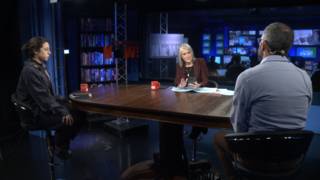
AMY GOODMAN: Achin Vanaik is a professor of international relations and global politics at Delhi University. He’s a founding member of the Coalition for Nuclear Disarmament and Peace, a group founded after India conducted its first nuclear test in ’98. Professor Vanaik joins us now on the line from New Delhi.
Your reaction to the lifting of this ban?
ACHIN VANAIK: Well, I think it’s a very sad day for India and the world. This is a — there are three aspects to this deal, and the consequences are negative in all three aspects: the strategic political dimension, in which India will now partner much more strongly than ever before the United States in its informal imperial project; second, of course, it’s a very sad day for all of us who are concerned about nuclear disarmament and the dangers of proliferation, both vertical and horizontal; and it’s also a bad day for those who believe that nuclear energy is outmoded and must be replaced by renewable sources of energy and that the direction of nuclear — civilian nuclear energy is a bad one.
JUAN GONZALEZ: The reports are that India is planning to build as many as thirty nuclear power plants. I would assume then that the Bush administration is also looking at the potential for business for American companies to get involved in that.
ACHIN VANAIK: The commercial aspect from the United States point of view is secondary to the strategic political dimension. After all, as you know, the United States has not built a nuclear reactor since 1979, or something like that, after Three Mile Island. And the French and the Russians are far ahead. The initiative for this deal, actually, did come from the Bush administration, not from New Delhi, and it was motivated primarily by the desire to consolidate and deepen the strategic relationship.
As for the thirty nuclear power plants that India wants to build — at the moment, it has about fourteen; in due course, it’ll be — have seventeen. But thirty is still a long way ahead. And the economics of building nuclear power plants is, of course, atrocious, horrendous, in so many ways.
AMY GOODMAN: We’re talking to Professor Vanaik in New Delhi in India. What does this mean for the relationship with Pakistan, the nuclear arms race? And also, at the same time this is going through without India signing the nonproliferation agreement, the US putting enormous pressure on Iran.
ACHIN VANAIK: Yes, well, you probably heard the — Manish Tiwari, I think I heard, in the Congress saying how wonderful it is, because India is able to get this deal without having to do anything with regard to nuclear proliferation. It can keep on building its nuclear arsenal. So, one obvious impact of this is that it is going to provoke Pakistan. They’ve already made it clear that they are going to try to establish more fuel supplies, and they’re going to build more bombs. So there’s a kind of impact on the nuclear arms race between India and Pakistan.
But that’s not the only arms race that is going to be — that’s going to be extended. It’s important to understand that this deal, to the delight of the Indian government, legitimizes its nuclear weapons policies, but this deal also legitimizes American nuclear weapons policies, and India is now a supporter of things like the ballistic missile defense system, the Proliferation Security Initiative, which is a guarantee that we are going to have a global nuclear arms race, because the ballistic missile defense system, as you know, is directed towards Russia and China. The Russians and Chinese don’t like it. They’re going to have to quantitatively and qualitatively expand their nuclear arsenals to overcome this attempted shield. And, of course, as the Chinese do so, then the Indians have to do so also, in order to counter the Chinese, and then the Pakistanis have to do so to counter the Indian ambitions. So, you have a dynamic of an arms race, which is also, to some extent, out of the hands of the Indians as a result of this particular deal.
JUAN GONZALEZ: And what is the reaction domestically among opposition groups within India to this spiraling involvement of the government in nuclear power?
ACHIN VANAIK: Well, with regard, there are — the two main opposition forces have been from the Hindu nationalist and Hindu communal force, the Bharatiya Janata Party, and from the left party, the communist party, being the Marxist and Communist Party of India.
The opposition from the right-wing Hindu nationalist and fundamentalist party is basically that, insofar as India was not going to test, then this could restrain India’s development. But we, of course, are not like the left. We want the strong strategic relationship with the United States. This deal isn’t quite good enough. That’s their sort of criticism.
On the part of the left, their preoccupation is, in many ways, nuclear nationalism, to some extent shared with the BJP, that, why can’t we just — we shouldn’t have this kind of restraint. Of course, if India tests, then, of course, what’s going to happen is that, both in the Nuclear Suppliers Group as well as in the United States, there would be huge problems in terms of the civilian nuclear cooperation.
But nuclear nationalism is something that we have to fight against. If we really want to move towards a world free of nuclear weapons and this disastrous situation that now exists, then we have to think much beyond this question of, “Oh, well, we are the nuclear goodies, and the others are the nuclear baddies. And we, the countries that have nuclear weapons, are somehow the great guardians of the nuclear world order, and we are reliable and can be trusted.” I mean, I find it astonishing that so many people worldwide are still prepared to swallow this.
AMY GOODMAN: Achin Vanaik, we want to thank you very much for being with us, professor of international relations and global politics at Delhi University, founding member of the Coalition for Nuclear Disarmament and Peace, speaking to us from New Delhi, India.




 Top
Top
Media Options