





 Watch Full Show

Related
Topics
Guests
- Sameh HabeebPalestinian journalist in Gaza City. He blogs at GazaToday.Blogspot.com
- Samer Badawithe Executive Director of United Palestinian Appeal, a Washington-based charity established in 1978 to assist needy Palestinians.
Sameh Habeeb is a Palestinian journalist in Gaza City. He joins us on the phone. We also speak with Samer Badawi, the executive director of United Palestinian Appeal, a Washington-based charity established in 1978 to assist needy Palestinians. [includes rush transcript]
Related Story
 StoryApr 19, 2024Over 100 Arrested at Columbia After Univ. President Orders NYPD to Clear Pro-Palestine Student Protest
Transcript
AMY GOODMAN:
We go now to Gaza City to Sameh Habeeb, a Palestinian journalist there blogging at gazatoday.blogspot.com. Describe the situation right now, Sameh.
SAMEH HABEEB:
Hello, Amy. In fact, I’m not from the Gaza Strip; I’m from the occupied Gaza Strip now. Well, the situation is very direful since the Israelis started their military ground operation. The situation has dramatically changed. We have like a kind of fear and panic across the residents of the Gaza Strip with the start of the military operation. The number of the victims dramatically rise, especially the civilians. Around yesterday — today’s statistic, around ninety people died and killed, mostly civilians, since the start of this military ground operation less than forty hours ago.
The Israelis maybe have information about the Israeli military operation and how it has started. It has started from key — four key points across the Gaza Strip, in the north and in east of Gaza and the south of Gaza. Now, Gaza yesterday was being cut into two pieces. The north of Gaza and Gaza City are being cut from the south and the middle areas of the Gaza Strip. No one is allowed to go out or in. And this is regarding the military steps of the Israelis.
In the area where I live, in the east of Gaza, the artillery shelling is still taking place. And a few minutes ago, around three shells landed in my area. And one guy was killed and two were injured in hitting two houses. And this was one family.
Now, we are speaking about the Israeli military operation and its escalation, which aimed at ending the firing the rockets and ending the Hamas regime here. But what we have on the ground, what we are touching here, is that like there is a random targeting for the civilians, and most of the victims who fall, who fell since the military operation has started, they are mostly civilians. And the militants that Israel is seeking, they are being hidden, not being appeared in the streets at all.
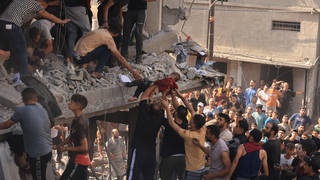
Today, in the early morning, there was a massacre in which around twenty to twenty-five people were killed from the same family in Al-Zeitoun area. Most of them were children. Israeli Army gathered around ten families in one of the houses for Al-Samouni family in Al-Zeitoun area south of Gaza City. They had gathered them in one house. And after a time, an artillery shell hit the house, and twenty to twenty-five were killed, and around more than sixty were injured, because the house was including around 100 individuals.
This is not the only massacre today. We have more people are being killed in the north, and more people are being killed in Gaza City itself. If you would like me to just state what we have today, I have a list of around thirty-two violations and ramifications of today’s actions. Israeli Air Force bombarded houses in Al-Shati refugee camp, and thirty-five people were wounded. And maybe more will be just dying, because the hospitals are not able to respond to the calamities we have, the catastrophes, because the Israeli siege, which was imposed around two years ago, completely paralyzed the ability of the clinics and hospitals to respond to any military operation or a war in such a scale like this.
AMY GOODMAN:
We’re also joined in Washington, D.C. by Samer Badawi, the executive director of United Palestinian Appeal, a Washington-based charity established in 1978 to assist needy Palestinians. Samer Badawi, as you listen to this description, how are people here, Palestinians and non-Palestinians, responding to the crisis in Gaza?
SAMER BADAWI:
Well, I think, as Phyllis said earlier, there’s been a tremendous groundswell of grassroots support for the people of Gaza over the last week. But more than that, I think as an organization that receives 99 percent of its donations from individuals across this country, we’ve seen a virtual cavalcade of support financially as well, because people understand that although goods and supplies are few and far between entering Gaza, there is a way to raise cash here in this country and provide it for organizations on the ground that are doing whatever they can, however they can, to provide relief.
AMY GOODMAN:
And the effect in the United States of the shutting down of many Arab charities, has that affected you?
SAMER BADAWI:
It’s very interesting, actually, Amy, because I think that more and more people in this country are viewing charity as a bit of an act of defiance in an atmosphere like the one that we’re viewing today. People across the country are wondering about how the context of all of this has been left out so egregiously in the media and in the statements of Israeli officials. And, as we have seen from the Holy Land Foundation case, there has not been a convincing argument made that by simply supporting the humanitarian needs of the Palestinian people, we are somehow creating — or committing a crime here in this country. I think UPA supporters are committed to the idea that providing financial support to the Palestinian people is not a crime, that it’s something that must be done, as it is done for suffering people throughout the world, including in Darfur, as it was done in Bosnia, as it’s been done around the world.
AMY GOODMAN:
Sameh Habeeb, we only have about fifteen seconds, but I wanted to ask about cell phone use in Gaza. Are you able to speak on cell phones? Sameh Habeeb, are you there?
Well, we will have to leave it there. I want to thank you all very much for being with us. Sameh Habeeb, speaking to us from Gaza City, Samer Badawi, executive director of the United Palestinian Appeal in Washington, D.C., as well as all of our guests today.



 Top
Top
Media Options