While the presidential candidates trade barbs and accuse each other of flip-flopping, they agree with President Bush on their enthusiastic support for nuclear power.
Filed under Weekly Column
It is fantastic to see Ingrid Betancourt free, but the celebration of her release should not be confused with celebration of the Colombian government.
Filed under Weekly Column
Democracy Now! and Free Speech TV team up with Aspen Public Access Channel, Grassroots TV, for historic national broadcast.
Filed under D.N. in the News
I was on a panel at the Aspen Ideas Festival in Colorado this week when Newsweek’s Jonathan Alter asked me, “Is Obama a sellout?” The question isn’t whether he is a sellout or not—it’s about what demands are made by grass-roots social movements of those who would represent them. The question is, who are these candidates responding to, answering to?
Filed under Weekly Column
The world lost one of its great comedians this week with the death at age 71 of George Carlin. Carlin had a career as a stand-up comic that spanned a half-century, in which he continually broke new ground, targeting those in power with his wit and genius.
Filed under Weekly Column
While the TV meteorologists document “extreme weather” with their increasingly sophisticated toolbox, from Doppler radar to 3-D animated maps, the two words rarely uttered are its cause: global warming.
Filed under Weekly Column
Amy Goodman on MSNBC’s Hardball, discussing the women’s vote in the 2008 election.
Filed under D.N. in the News
“This way to better media,” read the floor sign directing people through a skyway to the Minneapolis Convention Center. Thousands of people gathered there for the fourth National Conference for Media Reform, hosted by freepress.net. They came from all walks of life and all ages to address a central crisis in our society: our broken media system. I was one of the invited speakers.
Filed under Weekly Column
More Blog Posts »
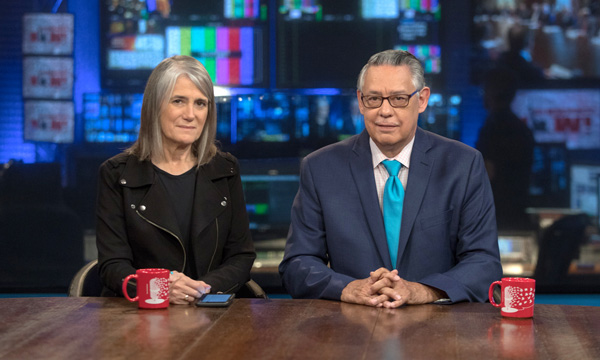
Democracy Now! is a national, daily, independent, award-winning news program hosted by journalists Amy Goodman and Juan Gonzalez. Pioneering the largest public media collaboration in the U.S., Democracy Now! is broadcast on Pacifica, NPR, community, and college radio stations; on public access, PBS, satellite television (DISH network: Free Speech TV ch. 9415 and Link TV ch. 9410; DIRECTV: Link TV ch. 375); and on the internet. DN!’s podcast is one of the most popular on the web.
Democracy Now!’s War and Peace Report provides our audience with access to people and perspectives rarely heard in the U.S.corporate-sponsored media, including independent and international journalists, ordinary people from around the world who are directly affected by U.S. foreign policy, grassroots leaders and peace activists, artists, academics and independent analysts. In addition, Democracy Now! hosts real debates–debates between people who substantially disagree, such as between the White House or the Pentagon spokespeople on the one hand, and grassroots activists on the other.
New stations are adding Democracy Now! to their programming schedules all the time, and there are several movements going on around the country right now to bring Democracy Now! to new communities. To find out more about these efforts, and how to get involved, click here.
WHY INDEPENDENT MEDIA ?
For true democracy to work, people need easy access to independent, diverse sources of news and information.
But the last two decades have seen unprecedented corporate media consolidation. The U.S. media was already fairly homogeneous in the early 1980s: some fifty media conglomerates dominated all media outlets, including television, radio, newspapers, magazines, music, publishing and film. In the year 2000, just six corporations dominated the U.S. media.
In addition, corporate media outlets in the U.S. are legally responsible to their shareholders to maximize profits.
And U.S. “public” media outlets accept funding from major corporations, as well as from the Corporation for Public Broadcasting, which has attempted in the past to exert political and editorial influence on public news producers.
Democracy Now! is funded entirely through contributions from listeners, viewers, and foundations. We do not accept advertisers, corporate underwriting, or government funding. This allows us to maintain our independence.