






 Watch Full Show

Related
Guests
- Kerim YildizKurdish human rights activist. He is the executive director and co-founder of the London-based Kurdish Human Rights Project. He was a former Amnesty Prisoner of Conscience and fled Turkey in 1986. His recent books include The Kurds in Iraq: The Past, Present, and Future and The Kurds in Syria: A Forgotten People.
Turkish warplanes and ground troops have attacked Kurdish militant positions inside northern Iraq, killing 34 members of the Kurdistan Workers Party, or PKK. The strikes follow a cross-border raid from Kurdish militants that killed 17 Turkish troops. We speak with Kurdish human rights activist Kerim Yildiz, executive director and co-founder of the London-based Kurdish Human Rights Project. He was a former Amnesty Prisoner of Conscience and fled Turkey in 1986. [includes rush transcript]
Related Story
 StoryOct 07, 2019“A Shakespearean Act of Betrayal”: Trump Agrees to Let Turkey Invade Kurdish-Controlled Syrian Area
Transcript
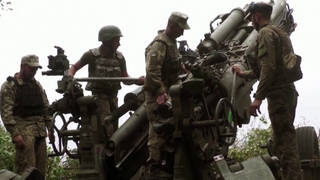
AMY GOODMAN: Turkish warplanes and ground troops have attacked Kurdish militant positions just inside northern Iraq over the last three days, killing 34 members of the Kurdistan Workers Party, known as the PKK. A Turkish military source told Reuters some 300 ground troops have advanced about six miles into Iraqi territory in cross-border raids.
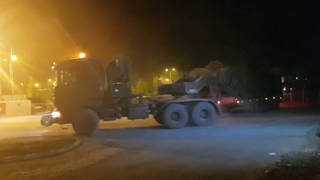
Turkey has been threatening to invade northern Iraq for days, and tensions remain high following the killing of as many as 17 Turkish soldiers by the PKK over the weekend. Meanwhile, the buildup of troops along the Turkish-Iraqi border continues, with military helicopters airlifting commando units into the area overnight. Kurdish fighters with the PKK have offered a ceasefire if Turkey abandons plans to launch cross-border raids, but Turkey has refused to negotiate with the PKK, which it considers a terrorist group.
Kerim Yildiz is the co-founder and executive director of the London-based Kurdish Human Rights Project. He was an Amnesty International Prisoner of Conscience and fled political persecution in Turkey in 1986. He was granted asylum in Britain. His group contributed to important reforms in Turkey and has also brought several cases before the European Court of Human Rights. Kerim Yildiz has written extensively about Kurdish issues. His latest books: The Kurds in Iraq: The Past, Present, and Future and The Kurds in Syria: A Forgotten People. He joins us now in our firehouse studio. Welcome to Democracy Now!
KERIM YILDIZ: Thank you.
AMY GOODMAN: Can you talk about what is happening on the border, the significance of it? Who is the PKK, the group that the U.S. and Turkey call a terrorist group?
KERIM YILDIZ: The PKK, Kurdish Workers Party, has been in conflict with the Turkish state since 1984. And since then, there were policy developed by the Turkish states to empty almost 3,000 villages and hamlets in Turkey, evacuated all those people forcibly. And this conflict bring right now at least three million IDP in Turkey. And the recent incident is not new, is not a unique incident. The same kind of incidents is happening last 15 years. During this conflict, almost 30,000 people were killed in both sides by the Turkish military side and by the Kurdish side. So, in that sense, I think what Turkey is doing right now is threatening the stability in the Kurdish region of Iraq at the moment. That is the point.
AMY GOODMAN: Al Jazeera English aired an exclusive interview on Tuesday with Masrour Barzani, the chief of intelligence and security in Iraqi Kurdistan. This is how Barzani explained the responsibility of the Kurdistan Regional Government, or the KRG, for attacks by Kurdish militants against Turkey.
MASROUR BARZANI: We are not a part of this problem. PKK existed long before the KRG was established. So this is not something that the KRG is responsible for. And we are not going to be a part of this, and we will not allow anybody to drag us into this internal problem. And we hope that Turkey also doesn’t export its own problems into our region. But if we, for any reason, become the target, and if KRG is the target of a bigger, let’s say, operation, then we will do everything we can to defend ourselves.
AMY GOODMAN: Kerim Yildiz, your response?
KERIM YILDIZ: Well, I think it is important to know, in our view, is the Turkish government has carried out such kind of military operations at least 20, 30, 40 times, last 10 years, and did not receive any response. I mean, the questions of the — the question is not the PKK; the question is about the rights of the Kurdish people. The rights of the Kurdish people right now in Turkey is constitutionally denied. The Turkey still has of the policy of denial toward the Kurdish people.
I mean, give you an example, the Kurds are still not allowed to use their mother tongue in everyday life in their politics.
AMY GOODMAN: Kurdish.
KERIM YILDIZ: The Kurdish people. So they have to speak in Turkish. I mean —
AMY GOODMAN: This was why Leyla Zana, who spoke in Kurdish before the Turkish parliament — she was a parliamentarian — was imprisoned.
KERIM YILDIZ: That’s precisely. I mean, you know, because she spoke in Kurdish, and she has been in prison with her colleagues over 10 years. And right now, there are pro-Kurdish party members in the Turkish parliament. The public prosecutor brought a case against them, because they were speaking Kurdish during the military — during the election campaign. I mean, the questions is actually directly related to the military incursion in Iraq, is directly related to the development of the Kurdistan Iraq and related to the oil issues, related to the Kirkuk referendum; it’s not issues of the PKK.
AMY GOODMAN: You think this is about oil?
KERIM YILDIZ: It is about oil. It’s about the development in Kurdistan Iraq, because Turkey is right now collaborating with the most repressive regime, like Iran and like Syria, despite they are trying to become a member of the European Union. The reason they’re doing that, they do not want to see any development in relation to the Kurdish self-determination in Iraq.
AMY GOODMAN: Do you think Turkey wants to take over Kurdistan?
KERIM YILDIZ: Well, what I think is, Turkey do not want to see the Kurds have either federalism, federal state, or autonomy in Iraq or any part of the Kurdistan. That’s why they are working together with Iran and Syria.
AMY GOODMAN: I interviewed historian and blogger Juan Cole Monday. I asked him about the significance of the PKK killing 17 Turkish troops over the weekend. I want to play an excerpt of what he had to say.
JUAN COLE: Imagine what would happen in this country if a guerrilla group based in a neighboring country came over the border and killed 17 U.S. troops. That would be a war. And the Kurdish guerrilla movement, the Kurdish Workers Party, based now in Iraq, but originally from Eastern Anatolia, from the Turkish regions, is conducting a guerrilla war against the Turkish military. It is being given safe harbor by Kurdish politicians on the Iraqi side.
And, in essence, the United States has created this situation in which a NATO ally — people forget Turkey fought alongside the United States in Korea; it’s got troops in Afghanistan — a NATO ally of the United States is being attacked and its troops killed by a terrorist organization, so designated by the State Department, that essentially has U.S. auspices. The U.S. is responsible for security in Iraq.
AMY GOODMAN: That’s Juan Cole. Kerim Yildiz, your response?
KERIM YILDIZ: Well, I mean, first of all, we have to understand this issue is, is there are armed conflicts in Turkey between the PKK and the Turkish states, and this is not the first armed conflict. And the armed conflict — 29 armed conflicts took place last 70 years, since the establishment of the Republic of Turkey. I mean, the question is all about the rights of the Kurdish people in Turkey, and it’s a question about democracy, freedom of expression, freedom of media in Turkey. It is not correct to say Turkey is a member of the NATO, Turkey a member of other international community. It is correct to say they are a member of this international institution; they have obligations. And those institutions has also obligation actually to ask Turkey to act with responsibility.
AMY GOODMAN: We only have 15 seconds, but how does the U.S. close relationship with Turkey, sending hundreds of millions of dollars of weapons to Turkey, affect the Kurds? What do you think people in the U.S. can do? Ten seconds.
KERIM YILDIZ: Well, first of all is, the money has been sent to Turkey and used in the army, and this army has used this money to kill the Kurds, to evacuate their villages and to violate the rights of the Kurds. Therefore, the United States department and the United States people must observe what actually happened on the ground, how their money has been used.
AMY GOODMAN: We’ll have to leave it there. I want to thank you very much, Kerim Yildiz, for joining us, Kurdish human rights activist who’s currently based in Britain. Thanks for joining us in New York.



 Top
Top
Media Options